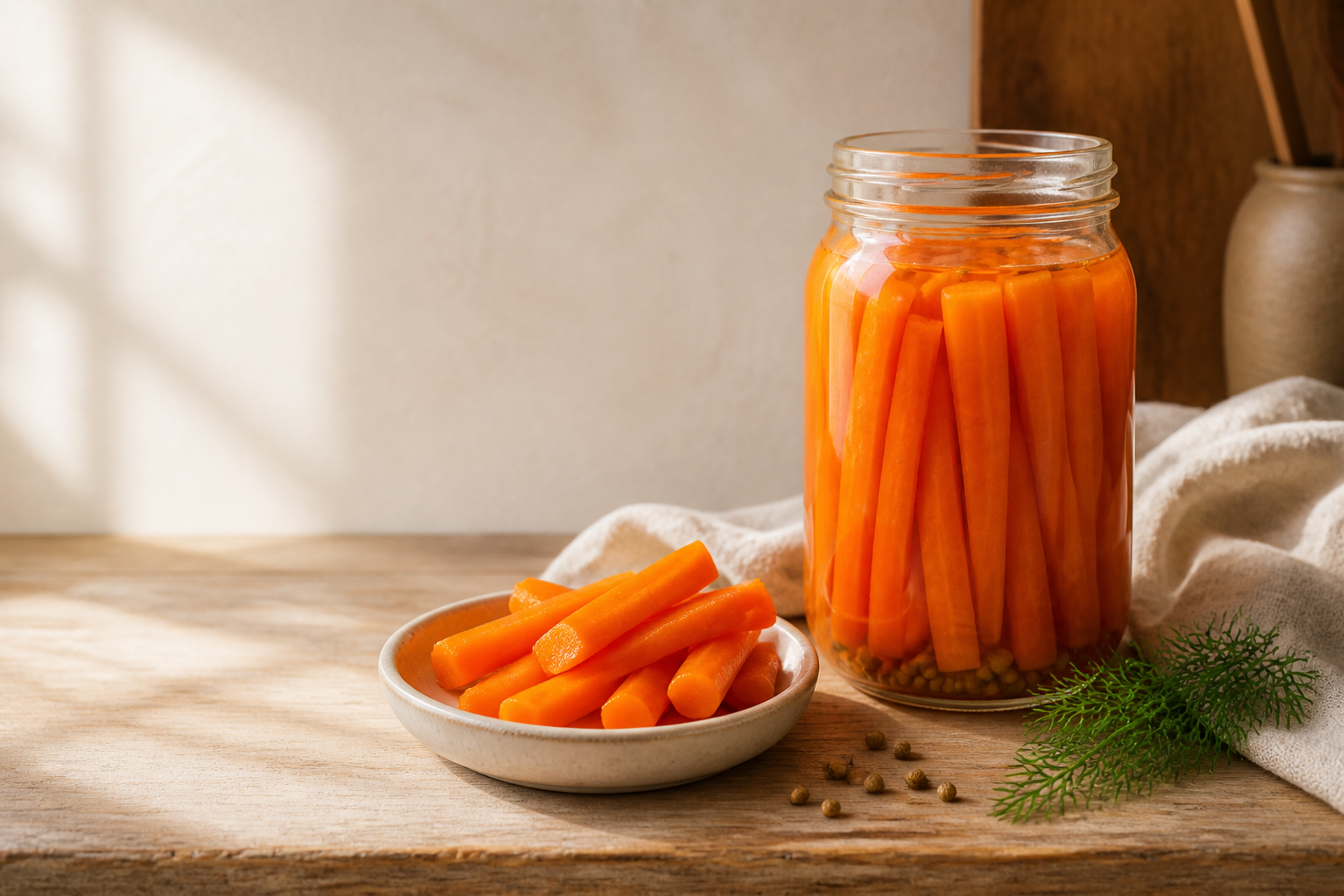
A good fermented hot sauce starts with peppers you want to eat. Ferment them until they are tangy, then blend them with a little brine and vinegar. Use sweet peppers for body, hot peppers for heat, or any mix in between. The 2.5% brine stays the same.
Recipe at a glance
- Makes: about 1 1/2 to 2 cups
- Peppers: 1 pound prepared peppers (450 g)
- Starting brine: about 2 cups (500 g by weight) at 2.5% salt
- Fermentation temperature: 70 to 75 degrees F (21 to 24 degrees C)
- Fermentation time: about 7 days to 3 weeks
- To finish: reserved brine and vinegar labeled 5% acidity
- Storage: refrigerate
Ingredients
For the pepper ferment:
- 1 pound fresh peppers, stems removed (450 g)
- 2 cups plus 1 tablespoon water (487.5 g)
- about 2 teaspoons canning or pickling salt (12.5 g; weigh it for an exact 2.5% brine)
- 1 small garlic clove, optional
- 1/2 teaspoon coriander seed or cumin seed, optional
For every 10 1/2 ounces drained fermented peppers (300 g):
- 1/4 cup reserved fermentation brine (60 g)
- 1/4 cup vinegar labeled 5% acidity (60 g)
Sweet red peppers give the sauce body and a ripe, fruity flavor. Jalapenos and serranos bring a greener heat. Fresnos and ripe red chiles deepen the color. For a milder sauce, make sweet peppers most of the batch and add hot peppers to taste.
Wear gloves while cutting hot peppers. Keep your hands away from your eyes and face, and open a window if you are working with very hot varieties.
Choose the flavor
Change these
- the mix of sweet and hot peppers
- one small garlic clove or a little whole spice
- how long you ferment within the 7-day to 3-week range
- how much brine or vinegar you add after blending
Keep these steady
- the 2.5% starting brine
- peppers and spices fully under the brine
- a 70 to 75 degrees F (21 to 24 degrees C) fermentation temperature
- starting with clean jars and tools
- refrigerating the finished sauce
Equipment
- 1 clean 1-quart wide-mouth Mason jar
- kitchen scale that reads to at least 0.1 gram
- clean bowl or measuring cup for mixing the brine
- food-grade fermentation weight
- fermenting lid and screw band
- blender
- calibrated food pH meter, strongly recommended
- clean bottle or jar for the finished sauce
- plate or tray for beneath the fermenting jar
Wash the jar and tools in hot, sudsy water, then rinse them well.
1. Mix the brine
Combine 2 cups plus 1 tablespoon water (487.5 g) with about 2 teaspoons canning or pickling salt (12.5 g). Stir until the salt dissolves.
The gram weights make exactly 500 g of starting brine at 2.5% salt. Cup and spoon measures are practical approximations, so weigh the water and salt when you want the ratio to be exact.
To make more or less brine:
- salt in grams = total brine in grams x 0.025
- water in grams = total brine in grams x 0.975
This is a wet brine, so the salt is calculated from the brine, not from the weight of the peppers.
2. Prepare the peppers
Put on gloves. Wash the peppers, remove the stems, and cut away any soft or spoiled spots.
Cut the peppers into pieces that will pack easily under the weight. Remove more seeds and pale inner ribs for less heat. Leave more in for a hotter sauce.
3. Pack the jar
Put the optional garlic or whole spice in the bottom of the jar. Add the peppers and pack them snugly without crushing them into a paste.
Leave room for the weight, the brine, and 1 to 1 1/2 inches of headspace.
4. Add the brine
Pour in enough brine to cover the peppers. Add the fermentation weight, then check around the edges for stray pepper pieces, garlic, or spices. Keep everything under the liquid.
Why fermented vegetables need to stay under the brine
5. Cover and ferment
Wipe the rim clean. Add the fermenting lid and screw band according to the manufacturer's instructions. Set the jar on a plate or tray.
Keep the jar at 70 to 75 degrees F (21 to 24 degrees C). Check the brine level and temperature each day.
Start checking the flavor after 7 days. If the peppers are still beneath the brine, with no fuzzy mold, rotten odor, or slime, use a clean utensil to taste a small piece. Stop when the peppers taste pleasantly tangy, or continue fermenting for up to 3 weeks for a deeper sour flavor.
Bubbles, cloudy brine, and sediment may appear. These changes can be part of an active ferment, but they do not tell you the final pH.
6. Check the batch
If you have a calibrated food pH meter, follow the manufacturer's instructions and test a sample that includes both peppers and brine. A reading of 4.6 or lower confirms that the ferment is acidic. The finished sauce still belongs in the refrigerator.
Throw out the batch without tasting it if you see fuzzy mold, smell a rotten or strongly unpleasant odor, or find the peppers slimy. Do not try to fix a spoiled batch by adding vinegar.
7. Drain the peppers
When the peppers taste tangy, remain beneath the brine, and have no fuzzy mold, rotten odor, or slime, drain them over a bowl and save the brine.
Weigh the drained peppers. Weight works better than cups here because different pepper varieties pack differently.
By now, the peppers should taste pleasantly sour, with less of the raw edge they had when they went into the jar.
8. Blend the sauce
This is where the fermented peppers become hot sauce. For every 10 1/2 ounces drained peppers (300 g), add 1/4 cup reserved brine (60 g) and 1/4 cup vinegar labeled 5% acidity (60 g).
Blend until smooth. For a thinner sauce, add more reserved brine. For a brighter, sharper sauce, add more vinegar. Work in 2-teaspoon additions (10 g) and write down what you use.
If you are tracking pH, test the fully blended sauce again. The added brine and vinegar can change the reading.
The finished sauce should be bright and tangy, with the color and heat of the peppers you chose.
9. Bottle and refrigerate
Pour the sauce into a clean bottle or jar and refrigerate it right away.
This is a refrigerator sauce, not a canning recipe. Do not store it at room temperature.
Use the sauce
Spoon it over eggs, tacos, beans, roasted vegetables, or grilled meat. A little also wakes up soups, marinades, and salad dressings.
For your next batch
Write down the pepper mix, fermentation temperature, number of days, pH if measured, and the amount of brine and vinegar you added. Next time, you can change the peppers or the finish while keeping the 2.5% starting brine in place.
Choose another fermentation project
Sources & technical references
We developed this recipe using published studies of fermented peppers and FDA guidance on food acidity.
- Kiczorowski et al.: Effect of fermentation of chosen vegetables on the nutrient, mineral, and biocomponent profile
- Toran-Pereg et al.: Physicochemical and Sensory Evaluation Data to Drive the Improvement of a New Ready-to-Use Hot Sauce
- Di Cagno et al.: Use of autochthonous starters to ferment red and yellow peppers
- FDA: Guide to Inspections of Low Acid Canned Food