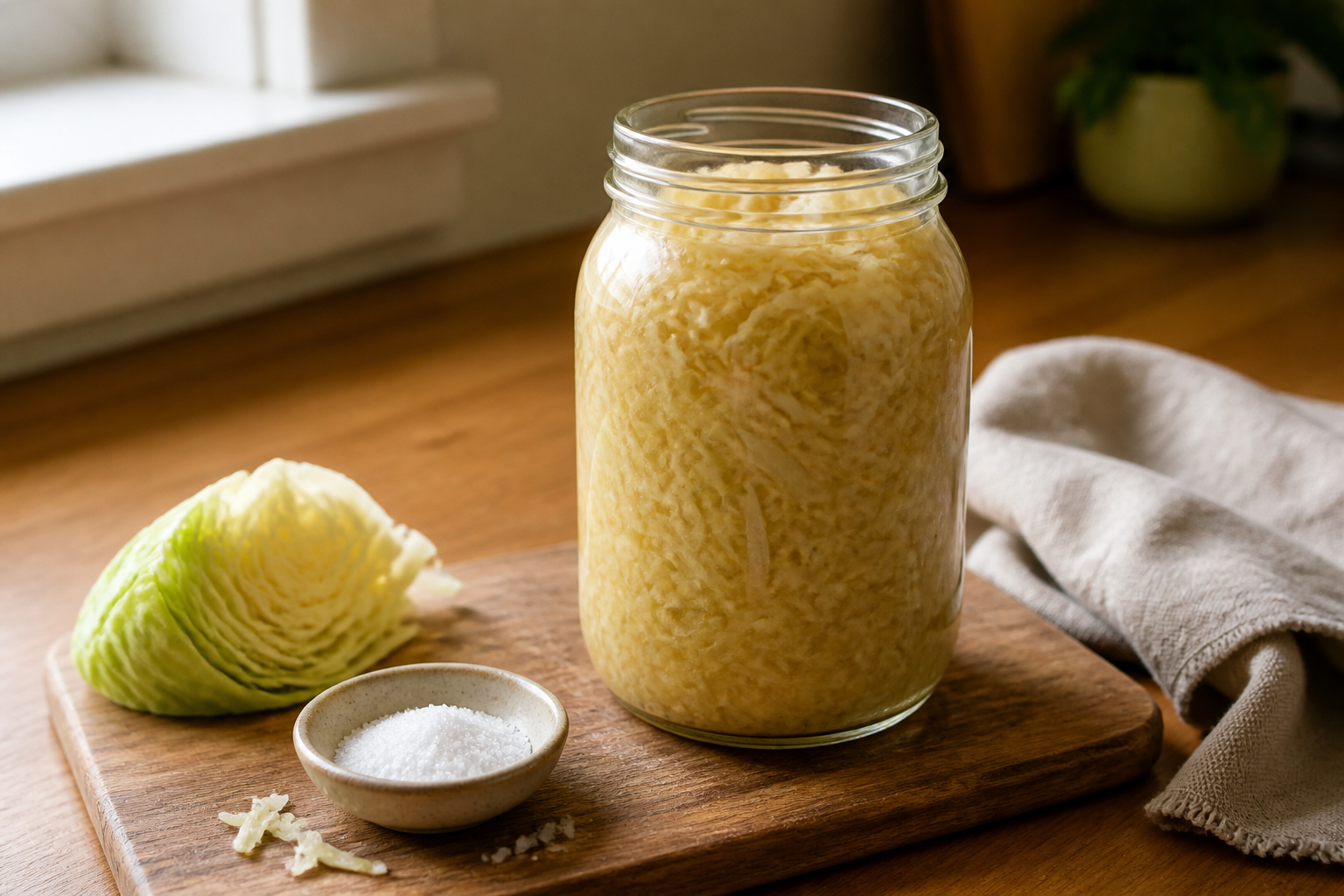
The brine line is one of the most useful things to understand in vegetable fermentation.
Keep the main vegetable mass under the brine. The liquid holds the vegetables in the recipe's intended salt concentration and keeps air away from the surface, where unwanted growth is more likely.
That does not mean one floating shred comes with an instant failure timer. It means exposed pieces deserve attention, not dismissal.
What the brine is doing
For wet-brined vegetables, a sourced method combines salt and water at a salinity suited to that vegetable and process.
For a dry-salted ferment such as sauerkraut, calculate salt from the vegetable weight. Salt draws liquid from the cabbage, and that liquid becomes the brine around the shreds.
For a wet-brined ferment such as whole cucumbers, calculate salinity from the separately mixed brine formula. Do not use a cabbage percentage as though it were a universal brine recipe.
Salt helps lactic acid bacteria outcompete many unwanted microbes. That is why the recipe's salt or brine ratio matters.
The practical rule is simple:
Keep the vegetables covered with the brine the recipe calls for.
Do not turn that principle into one universal brine formula. Different vegetables and methods can call for different salt concentrations.
Why the surface is different
Vegetables beneath liquid are in a lower-oxygen environment than pieces sitting in the air above it. That low-oxygen environment supports the intended fermentation while exposed surfaces are more vulnerable to unwanted growth.
The goal is prevention. Keep the main vegetable mass under the liquid, keep loose pieces from collecting above it, and respond to a falling liquid level by checking the method's required salinity and using a compatible brine when additional liquid is needed.
Why a packed jar can still move
A jar is not static once fermentation begins.
Shredded or cut vegetables can shift. Small pieces can work around the edge of a weight. Fermentation produces carbon dioxide, and that gas moves through the brine as bubbles.
How to keep a jar submerged
- pack the vegetables firmly when the method calls for it
- include the appropriate brine or natural liquid
- use a suitable weight or cover method
- confirm that the food remains submerged
- cover the vessel as the method directs
- monitor the batch
What you can change and what you should keep steady
Experiment with
- compatible herbs, spices, garlic, chile, and aromatics;
- a food-safe weight or cover that fits the vessel and performs the intended job;
- vessel size when the full method, proportions, headspace, and monitoring plan are adapted with it;
- how sour the ferment becomes within the appropriate process window.
Keep these steady
- salt concentration and food-to-brine relationships;
- submersion and outside-air exposure;
- temperature, time, and adequate acidification;
- food-contact materials and shelf-stable canning instructions.
Start with packing
For shredded ferments such as sauerkraut, firm packing presses out open space and helps the cabbage's own liquid rise around the shreds.
A tamper makes that physical job easier. It reaches into the jar and applies even pressure.
Packing helps the cabbage's liquid rise, but you still need measured salt, the right temperature, and enough time.
Then choose a suitable way to hold it down
More than one weighting method can work. The right choice depends on the vessel, food-contact material, fit, and fermentation method.
1. A plate weighted with water-filled jars
For a large crock, a dinner plate or glass pie plate can sit over the vegetables and be weighed down with sealed jars filled with water.
This is a practical large-container method. It is not sized for a one-quart Mason jar.
2. A food-grade bag filled with brine
A sealed food-grade bag filled with compatible brine can conform to the surface and provide downward pressure.
The details matter. Use food-grade material, not a garbage bag or trash liner. Fill the bag with brine compatible with the ferment so a leak does not dilute the jar with plain water.
Use a larger bag for a crock or a small freezer-weight bag for a one-quart jar. In either case, the brine inside the bag should match the ferment's compatible top-up formula.
3. A food-grade stainless-steel spring
A food-contact stainless-steel spring made for a wide-mouth jar can hold cabbage beneath liquid.
Use a product intended for food contact and for the vessel in question. Fit and material both matter.
4. A food-grade glass fermentation weight
A purchased food-grade glass disk is another compact option for a one-quart jar.
A glass weight has one clear job: apply downward pressure while the brine remains above the food. It is compact and reusable, which makes it well suited to a small Mason jar.
It does not choose the salt, set the temperature, tell you when the ferment is finished, or guarantee success. It solves submersion.
What about a cabbage leaf?
Some fermenters place a cabbage leaf over small shreds to keep the top of the jar organized.
A cabbage leaf by itself is not a weight. It is still food, so it also needs to remain submerged. Treat it as a follower that organizes small shreds, not as proof that the submersion job is finished.
What about a shot glass or another improvised object?
An object does not become suitable for fermentation just because it fits inside the jar.
Food-contact material, stability, cleanability, and fit all matter. Avoid copper, iron, galvanized metal, lead-glazed crocks, and non-food-grade liners.
Use a weight designed for food contact and suited to the vessel you are using.
A weight and an airlock do different jobs
This distinction clears up a lot of confusion:
Weight: helps control where the food stays.
Airlock: helps manage the vessel's gas path and outside-air exposure.
An airlock lets fermentation gas escape while helping limit outside air intrusion. It does not hold vegetables down.
A weight does not vent gas or cover the vessel.
Neither one fixes unsuitable salinity, temperature, food-contact materials, or a method that has not been adapted to the vessel.
If pieces rise above the weight
Do not panic, and do not ignore them.
Check:
- whether all solids are still covered with liquid
- whether the jar was packed firmly enough
- whether the weight has shifted
- whether the vessel is overfilled
- whether the headspace fits the method
- what salinity the method requires if additional liquid is needed
Do not top up the jar with plain water or a guessed salt solution. Use the top-up brine listed for the recipe. If the recipe does not give one, check before adding anything.
Normal ferments vary. A floating shred, cloudy brine, sediment, or changing aroma should be evaluated in context rather than treated as automatic failure. Discard the batch without tasting if you see fuzzy mold, smell a rotten or putrid odor, or find the vegetables slimy.
What each part does
Each part solves one practical problem:
- Method: defines the food, salinity, liquid, temperature, time, and acidification checks
- Packing: reduces loose space and places the food below
- Weight: helps hold the food down
- Brine: surrounds the food with the intended salt-and-liquid environment
- Cover or airlock: manages the top of the vessel as directed
- Monitoring: confirms that the setup keeps doing its job
A tamper packs the jar. A weight holds food down. An airlock lets gas escape. Choose the tool that solves the problem you actually have.
Put the principle into practice
The classic one-quart sauerkraut recipe shows this system in a real jar: measured cabbage and salt, firm packing, enough liquid, a suitable weight, appropriate headspace, and daily checks.
Make classic small-batch sauerkraut
Sources & technical references
- University of Minnesota Extension: Preserving Food at Home, Fermentation
- National Center for Home Food Preservation: Suitable Containers, Covers, and Weights for Fermenting Food
- Penn State Extension: Let's Preserve, Fermentation, Sauerkraut and Pickles
- National Center for Home Food Preservation: General Information on Fermenting
- Oregon State University Extension Service: Small Batch Sauerkraut Tips
- Zabat et al.: Microbial Community Analysis of Sauerkraut Fermentation
- Plengvidhya et al.: DNA Fingerprinting of Lactic Acid Bacteria in Sauerkraut Fermentations