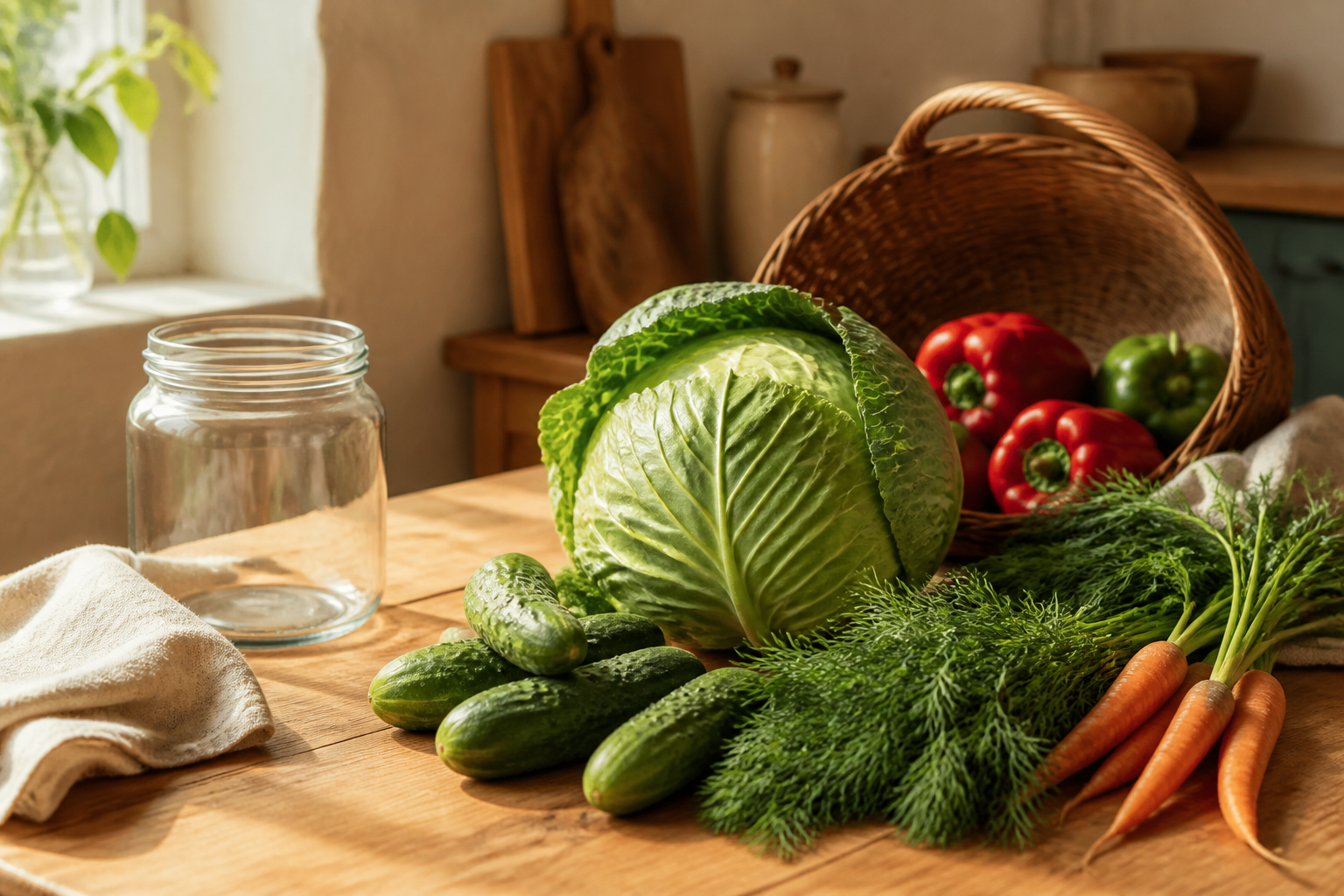
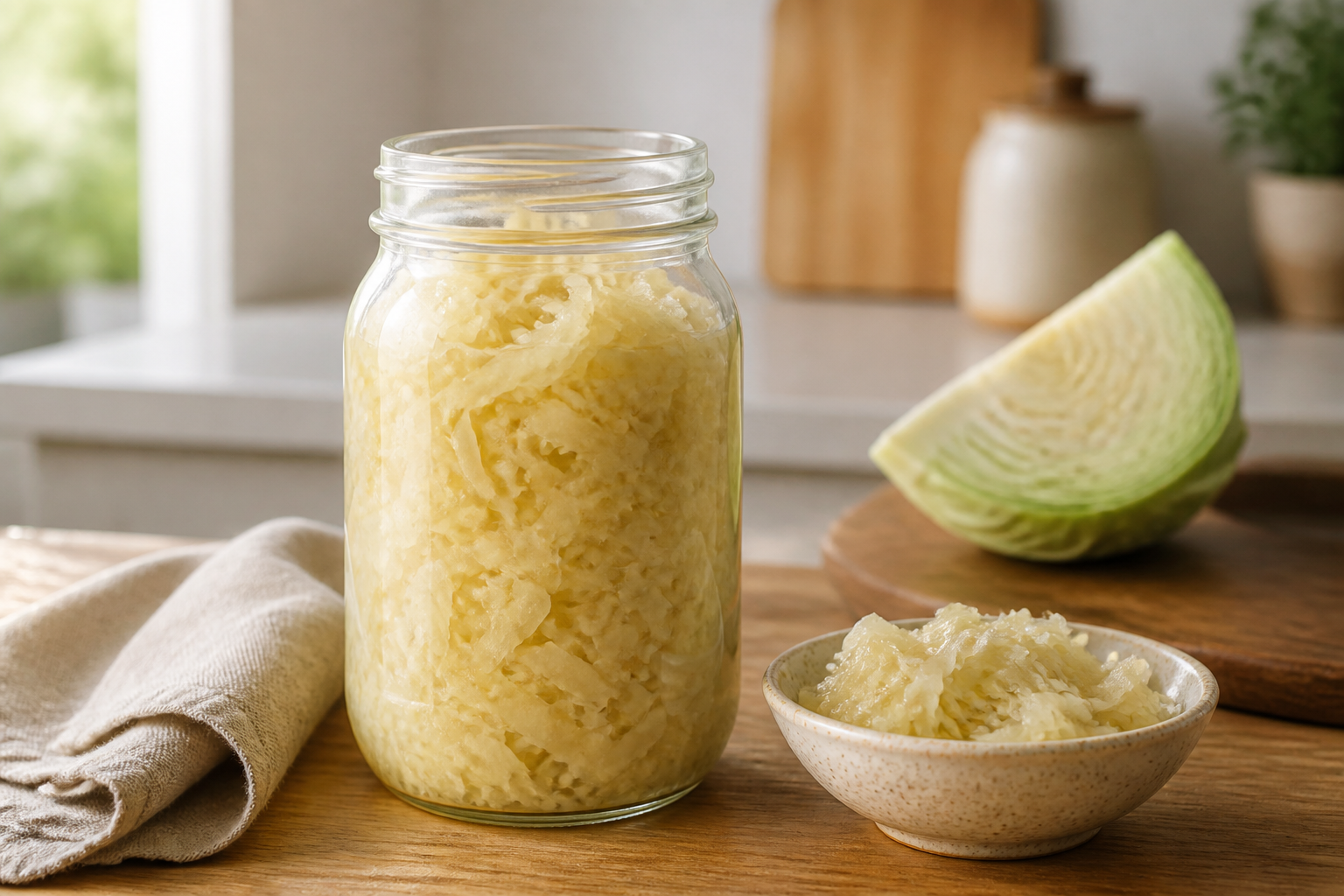
One quart of sauerkraut is enough to learn the full rhythm: measure, salt, pack, submerge, cover, wait, check, and refrigerate.
Before you begin
For one quart of sauerkraut, you will need:
- 1 1/4 pounds mature, firm cabbage
- about 2 1/4 teaspoons canning or pickling salt (12.8 g; weigh it for the exact 2.25% ratio, or use 13 g on a whole-gram scale)
- 1 clean 1-quart wide-mouth Mason jar
- a large mixing bowl
- a kitchen scale
- a knife, mandoline, kraut cutter, or food processor
- a suitable food-grade fermentation weight
- a fermenting lid and screw band
- a tamper or another appropriate packing tool
- a clean plate or tray for beneath the jar
Choose a spot where the jar can stay between 70 and 75 degrees F. Put the jar on a plate or tray before you fill it.
Learn the stop signs before you start. If you see mold, feel a slimy texture, or notice a bad odor, do not taste the sauerkraut. Discard the batch.
1. Prepare the cabbage
Remove the outer leaves. Rinse the cabbage under cold running water and let it drain.
Cut the head into halves or quarters. Remove the core and any damaged tissue. Shred the cabbage into long, thin pieces, about the thickness of a quarter.
Weigh out 1 1/4 pounds, or about 567 grams, of cabbage. This recipe uses salt equal to 2.25% of the cabbage weight. If the cabbage weight changes, multiply the new weight in grams by 0.0225 to calculate the salt.
2. Add the measured salt
Sprinkle about 2 1/4 teaspoons of canning or pickling salt (12.8 g) evenly over the cabbage. Weigh the salt for the exact 2.25% ratio. If your scale reads only whole grams, use 13 g.
Mix thoroughly with clean hands. At first, the shreds will still feel crisp and dry. Keep mixing. Salt draws liquid from the cabbage, and the cabbage will soften as liquid collects in the bowl.
Salt gives lactic acid bacteria an advantage over many unwanted microbes. Those bacteria consume sugars in the cabbage and produce lactic acid, which lowers pH as the ferment develops.
Weigh the salt rather than estimating it by eye. Less salt can make the ferment less reliable. Too much can slow it down.
3. Pack the jar firmly
Add the cabbage to the jar a handful at a time. Press each layer down firmly and evenly.
As the cabbage compacts, its liquid should rise around the shreds. Pour in any liquid left in the bowl.
Leave at least 3 to 4 inches between the packed cabbage and the top of the jar.
4. Keep the cabbage beneath the liquid
The cabbage needs enough liquid to cover all the solids.
Place a suitable food-grade weight on top. The weight does not make fermentation happen. It helps keep the cabbage submerged as the contents shift.
If the cabbage has not produced enough liquid, make this compatible backup brine:
- about 1 1/4 teaspoons canning or pickling salt (6.8 g; weigh for precision)
- 1 cup hot water (240 g)
Dissolve the salt in the hot water, then let it cool. The backup brine is calculated from salt and water because it is mixed separately from the dry-salted cabbage. Add only as much as needed to cover the cabbage.
Do not dilute the jar with plain water or invent a random brine. Different vegetables and methods can require different salinity. Use a compatible brine for the method you are following.
Why fermented vegetables need to stay under the brine
5. Cover the jar
Wipe the rim clean. Attach the fermenting lid and screw band according to the manufacturer's instructions.
Set the jar on the plate or tray. The measured cabbage and salt, temperature, time, and submersion still matter even when you use a purpose-built lid.
6. Ferment within the method's temperature range
Keep the jar at 70 to 75 degrees F. In that range, a one-quart batch may finish in about 1 to 2 weeks.
At 60 to 65 degrees F, it may take 2 to 3 weeks. Below 60 degrees F, fermentation can slow substantially. Above 75 degrees F, the sauerkraut may soften.
Check the jar every day. Confirm that the cabbage remains covered with liquid and the jar stays within the method's temperature range.
7. Watch the whole batch
The cabbage may settle. Gas may move through the liquid. The brine may become cloudy, and the aroma will change as raw salted cabbage becomes sauerkraut.
One bubble, one smell, or one calendar date does not tell the whole story. Each day, check that the cabbage is still below the liquid, the jar is in range, the surface is clear, the aroma is becoming tangy, and the cabbage remains firm.
If you see fuzzy mold, feel a slimy texture, or smell a rotten or putrid odor, do not taste the batch. Discard it.
8. Decide when it is finished
The calendar gives you a window, not an alarm.
Within the expected conditions, finished sauerkraut should smell and taste like kraut rather than raw salted cabbage. It should remain firm, not soft or slimy.
pH can be a useful verification tool. A finished ferment should reach pH 4.6 or lower, but pH alone is not permission to ignore salinity, temperature, time, submersion, aroma, or texture.
When it tastes as tangy as you want, the cabbage is still firm, and there is no fuzzy mold, rotten odor, or slime, move the jar to the refrigerator.
9. Refrigerate the finished sauerkraut
Remove the fermenting lid and replace it with a clean storage lid. Keep the sauerkraut tightly covered in the refrigerator.
Fully fermented sauerkraut can keep refrigerated for several months. If you want to freeze or can it for longer storage, follow a separate research-based preservation method.
What each part of the setup did
The Mason jar
It held the one-quart batch in a visible, manageable vessel. The same 2.25% cabbage-to-salt calculation can be used for a larger batch when the vessel, headspace, packing, and monitoring plan change with it.
The packing tool
It pressed the cabbage firmly into the jar and helped the cabbage's own liquid rise.
The fermentation weight
It helped keep the cabbage beneath the liquid as the contents shifted.
The fermenting lid
It covered the jar while fermentation produced gas. It did not replace the measured cabbage-to-salt relationship, temperature control, or daily checks.
The recipe
It set the cabbage-to-salt relationship, headspace, temperature, timing, and compatible backup brine. The tools made the physical work easier. The formula, temperature, and daily checks kept the batch on track.
What you can change and what you should keep steady
Experiment with
- a small amount of grated carrot, beet, turnip, kale, hot pepper, garlic, or juniper berries;
- batch size, as long as the cabbage and salt are weighed together at the same 2.25% ratio;
- how tart the kraut becomes within the appropriate process window.
Keep these steady
- the cabbage-to-salt relationship;
- submersion and low-oxygen conditions;
- temperature, time, and adequate acidification;
- any shelf-stable canning instructions.
Use the standalone recipe when you are ready to cook from a compact ingredient list and method.
Make classic small-batch sauerkraut
Sources & technical references
The 2.25% formula and process guidance are supported by these references.