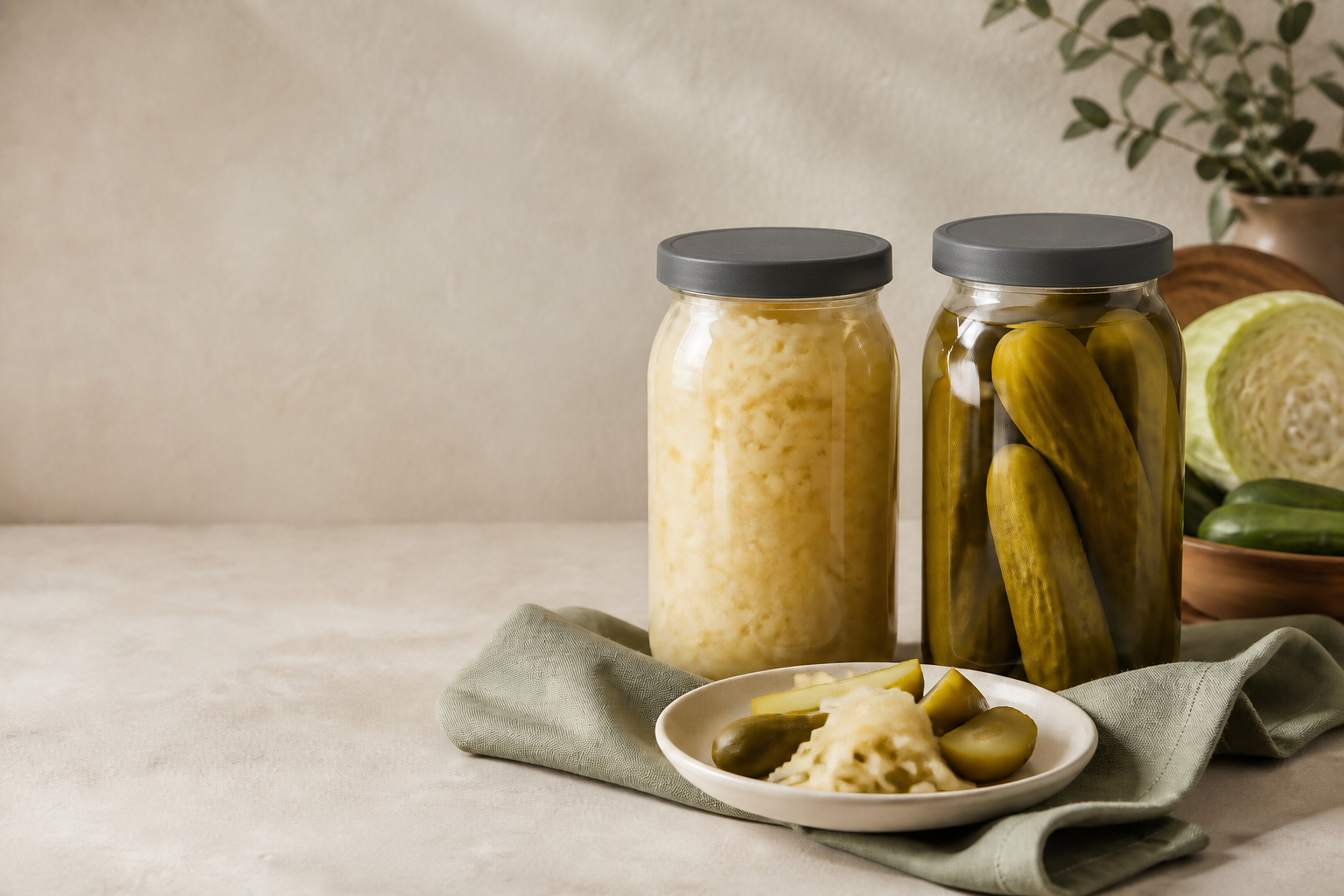
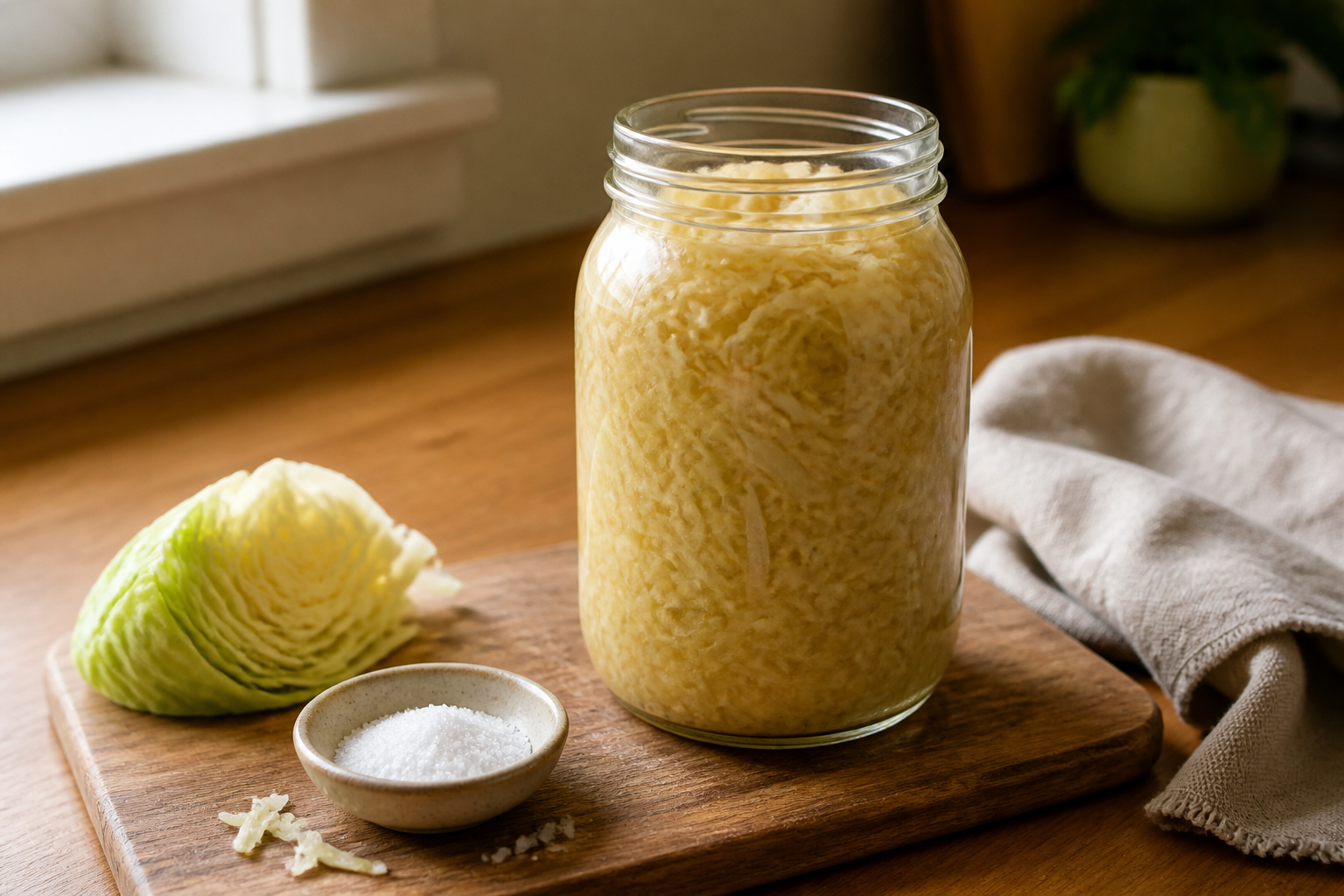
When the garden, CSA box, or market haul gives you more vegetables than this week's meals can absorb, fermentation gives you room to play.
Choose the food first. Then keep the recipe's salt, brine, temperature, and timing steady while you make the flavor your own.
Start with what is abundant
Look at what needs a plan while it is still fresh. A firm head of cabbage can become sauerkraut. A pile of short, firm pickling cucumbers can become fermented dill pickles.
You do not need to master the whole category before you begin. Choose good produce, use a reliable method, and learn what each variable is doing.
Two seasonal projects that are ready now
Cabbage: make small-batch sauerkraut
Mature, firm cabbage is the starting point. Mid- to late-season cabbage is especially well suited to kraut, although supermarket cabbage can be used year-round.
The Elementi recipe uses 12.8 grams of canning or pickling salt for 567 grams of cabbage, a 2.25% dry-salt formula. A whole-gram scale can be rounded to 13 grams. The batch size can change as long as the salt is recalculated from the cabbage weight and the vessel, headspace, packing, and monitoring plan change with it.
Make Classic Small-Batch Sauerkraut
Pickling cucumbers: make fermented dill pickles
Choose firm pickling cucumbers, not overgrown slicing cucumbers. The Elementi recipe gives ingredient quantities for each gallon of container capacity.
Scaling is more than filling whichever jar is nearby. Recalculate the salt, water, and 5%-acidity vinegar together, then preserve submersion, temperature, and time.
Make Classic Fermented Dill Pickles
Use the best produce for the jar
Fermentation does not rescue vegetables that are already soft, spoiled, or badly damaged.
Choose produce that is:
- fresh and firm;
- free from spoilage;
- mature enough for the method;
- the size and type the method calls for.
Trim damaged tissue as directed. If a vegetable is better suited to tonight's dinner, the freezer, or the compost, let it take that path. The jar should begin with sound ingredients.
Make the flavor your own
Salt, submersion, temperature, time, and acidification control the process. Flavor additions give you room to make the ferment your own.
Experiment with
- a small amount of carrot, beet, turnip, kale, hot pepper, garlic, or juniper berries in sauerkraut;
- optional garlic, dried red pepper, or mixed pickling spices for dill pickles;
- how sour the finished ferment becomes within the method's temperature and fermentation window;
- batch size when a reliable proportional formulation supports it.
Keep these steady
- the cabbage-to-salt relationship or brine concentration;
- the amount and acidity of vinegar where the method uses it;
- submersion and low-oxygen conditions;
- temperature, fermentation time, acidification, and any shelf-stable canning process.
Salt is not merely seasoning. In fermented sauerkraut and brined pickles, it favors lactic acid bacteria while inhibiting many competing microorganisms. Too little can weaken that selective environment. Too much can slow the fermentation.
A simple seasonal routine
- Sort the produce while it is still fresh.
- Decide what you actually want to eat later.
- Choose a reliable fermentation method for that vegetable.
- Read the recipe and choose a vessel with the headspace it calls for.
- Weigh the vegetables, salt, water, and vinegar exactly as the recipe directs.
- Add herbs, spices, garlic, or chile where the recipe gives you room.
- Ferment only what you can monitor and store as directed.
- Use the rest fresh, frozen, canned, dried, shared, or composted.
Ferment only the vegetables you will be excited to open weeks from now.
Choose your next jar
If cabbage or cucumbers are already on your counter, begin with the matching recipe. If you are still deciding, compare the two projects by the finished food you want most.
Sources & technical references
- National Center for Home Food Preservation: General Information on Fermenting
- National Center for Home Food Preservation: Selection of Fresh Cucumbers
- National Center for Home Food Preservation: Dill Pickles
- Oregon State University Extension Service: Small Batch Sauerkraut Tips
- Zabat et al.: Microbial Community Analysis of Sauerkraut Fermentation
- Plengvidhya et al.: DNA Fingerprinting of Lactic Acid Bacteria in Sauerkraut Fermentations